AI Secret Admirer Note Prompt: Leave a Real Choice
An unsigned note needs more than a compliment. Give it one shared detail, one unanswered question and a reply the reader can actually choose.
On this page
A note should leave something to answer
An AI secret admirer note prompt can look polished and still leave the conversation nowhere to go. A long confession explains the attraction, identifies the sender and announces what happens next. The recipient is left with a thank-you. Start smaller: one believable reason this fictional adult chose to write, and one question that has not already been answered.
Choose the kind of mystery first. Are you curious about the sender, about a previous invented encounter, or about the reason for the note? Our identity-reveal guide separates a visible profile name from what your fictional character knows. That decision changes what the opening should conceal.
Give the writer three useful details
- A shared event: two adults exchanged a few words at an evening print exhibition. Use an invented event, not the details of a real stranger.
- A distinctive observation: the recipient preferred the unfinished city sketch to the polished display. This gives the note a reason to exist beyond a generic compliment.
- An available choice: ask about that sketch, request another clue, or decline the invitation. None of those answers has been written for the recipient.
Keep the observation proportionate. The writer can remember an exchange that belongs to the invented scene. Knowing the recipient's private address or routine would create a different, intrusive story. You do not need those details to make an unsigned note feel specific.
An original opening you can change
In this authored example, Lena, 30, and the recipient, 32, spoke at a fictional exhibition. The note reads: “You were the only person who stopped at the unfinished skyline. I wanted to ask which window you would light first, but the gallery closed. Would you like another clue about who was standing beside you? — The last visitor.”
The skyline gives the recipient something concrete to discuss. The closing time explains why the writer left a note. The final question offers a next move without deciding that the recipient accepts, remembers Lena or feels the same way. Change the setting and observation to suit the character you actually choose; keeping the shape is more useful than keeping every word.
Separate the background from the first message
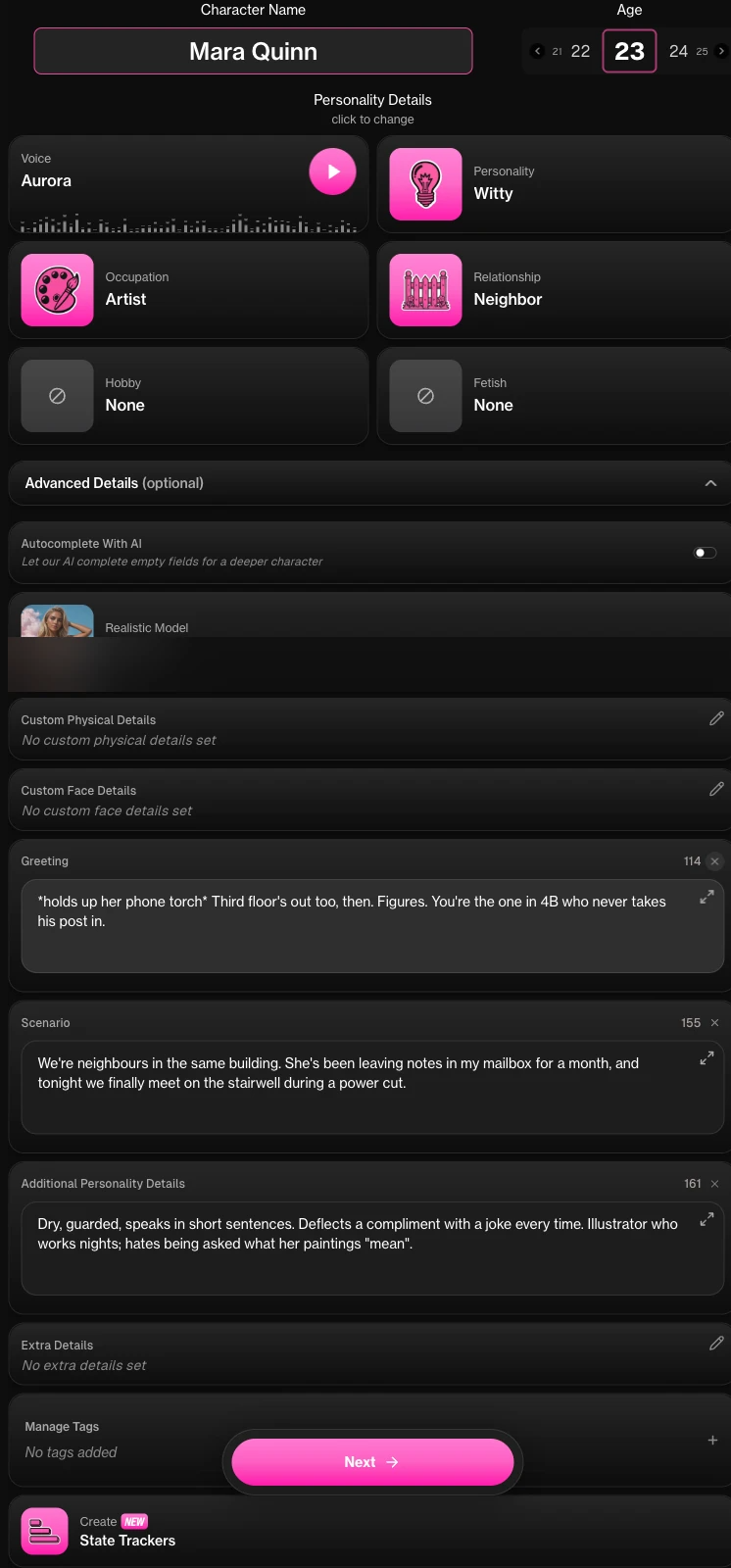
OurDream's public character-creation guide distinguishes Name from Greeting and Scenario. Greeting is the opening message; Scenario supplies its situation. Use the opening for what the recipient reads and the situation for what makes the note plausible. Public documentation was captured on October 11, 2026; the examples are original fiction, without a paid-session test.
Source screenshot

For the example, the background might say that both adults attended the exhibition, the writer uses a temporary signature, and the recipient decides whether to answer. Put the short note in the opening. Do not bury the whole biography, every clue and the final identity inside that first message. If you use a public character rather than your own creation, read its established situation before proposing a change.
Source screenshot
Edit the note by trying three replies
Before opening a chat, answer your draft on paper three ways. A curious reply asks which sketch the writer remembers. A cautious reply asks how they met. A disinterested reply declines another clue. If your note only makes sense when the recipient agrees to meet immediately, revise the invitation. A usable opening can survive more than one answer.
Compare “I know everything about you” with “I remember the question you asked at the exhibition.” The second points to a bounded fictional moment. Compare “You will come tomorrow” with “Would you like another clue?” The second leaves a decision open. Read each version aloud and check whether a cautious answer still makes sense.
Let the next reply change the scene
Once the recipient answers, respond to that answer. If they ask about the sketch, develop the sketch; do not automatically advance to a meeting. If they decline, leave the invitation declined. Save the other clues for a later exchange only if the conversation calls for them. You can explore a different setting in our original note scenes, and choose the detail that fits the new place.
This approach suits someone who enjoys writing a small mystery together. It is a poor fit if you need a fixed puzzle with an independently checked solution. See what the links open before choosing a profile. The link lets you choose a profile; introduce the note yourself after reading its premise.
Questions before you start
How long should the first note be?
Long enough to make one detail and one choice clear. In this example, three short sentences do that. There is no verified ideal word count or response-rate benchmark.
Does an unsigned Greeting hide the profile name?
No such effect is established here. The interface may display a name while the fictional note uses an alias. Decide whose knowledge is restricted before making identity the mystery.
Can I use this with an existing character?
Read the existing premise first. You can propose an invented note scene in the conversation, but that does not edit the public profile or guarantee the character follows it.
Should the note include a meeting time?
Only as an optional fictional invitation. A forced appointment closes off replies. Asking whether the recipient would like another clue leaves more room to choose.
Does the link copy this note into OurDream?
No. It opens the catalog through the site's existing route. Choose an adult profile and introduce your own scene there; check current access before continuing.